
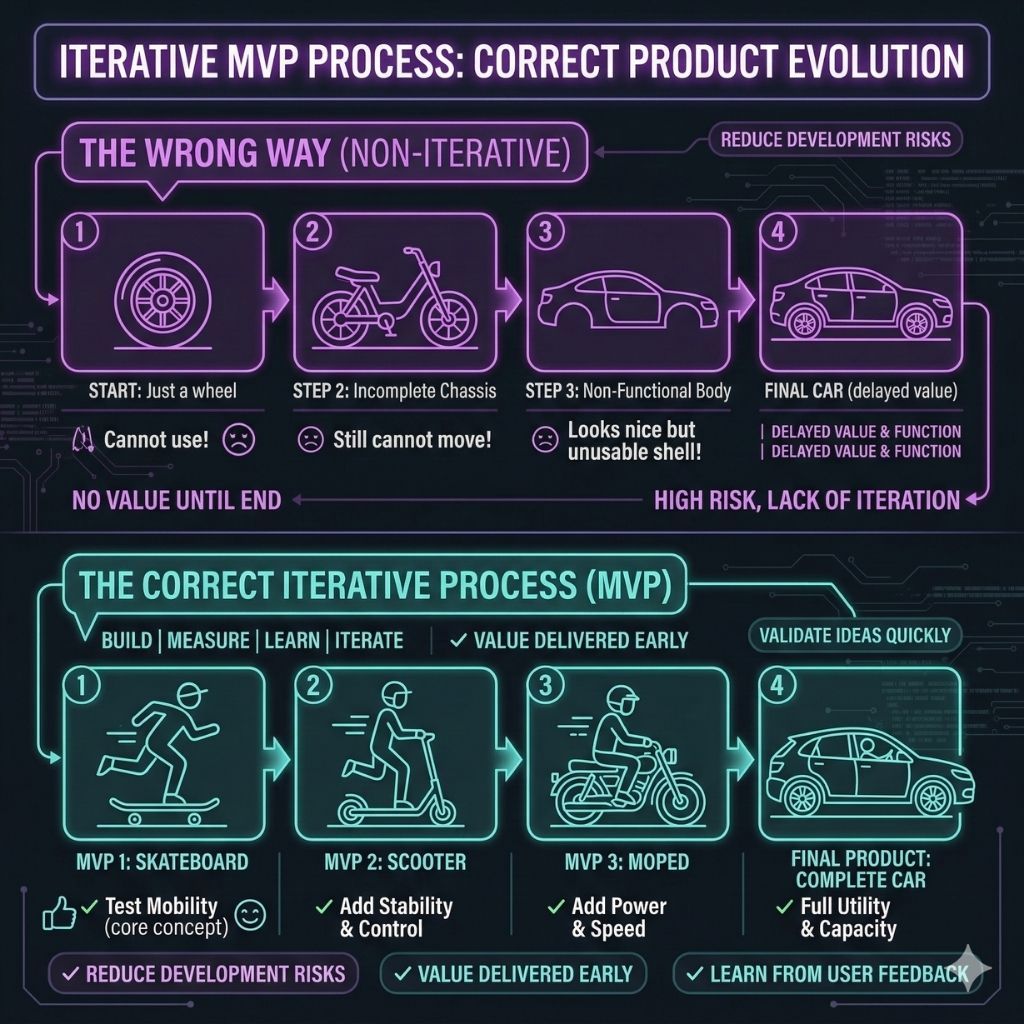
The concept of the Minimum Viable Product (MVP) has been wildly distorted. Too many founders use “MVP” as an excuse to launch a buggy, half-finished application, while others fall into the trap of “feature creep,” spending a year and a million dollars building a V1 that is anything but minimal. To successfully launch a product, you have to ruthlessly redefine what your MVP actually is.
The core function of an MVP
An MVP is not a smaller version of your ultimate vision. It is an experiment. The sole purpose of MVP creation is to validate or invalidate your core business assumption as cheaply and quickly as possible. If your assumption is that people will pay to have dog food delivered, your MVP isn’t a custom-built app with AI-driven nutritional recommendations; it is a simple landing page and a Stripe checkout link.
You’ll typically see the most successful founders launching MVPs that are embarrassingly simple, focusing 100% of their engineering effort on solving the user’s primary pain point and 0% on secondary “delight” features.
The danger of feature creep
Feature creep is the silent killer of startups. It happens when teams say, “We just need to add this one more thing before we launch.” Before long, the launch date is pushed back six months, and the budget is gone. You end up building a complex product in a vacuum, without any real-world feedback to tell you if you are building the right things.
A true MVP should hurt a little to launch. It should lack the polish and the secondary tools you dream of. By forcing your product launch out the door early, you allow the market to guide your roadmap. Your early adopters will quickly tell you exactly which features they actually care about, saving you from wasting months coding tools nobody wants.
Validating through behavior, not surveys
People will tell you they love your idea, but their actions are the only metric that matters. An MVP forces users to make a choice. Either use the product (and pay for it) or don’t. By launching a lean, focused product, you gather behavioral data that is infinitely more valuable than any focus group, allowing you to confidently secure funding or invest your own capital into scaling the software.