
In the battle of short form vs. long form video content, only one can win…right? Well, not exactly. Creating videos for your business is a tried-and-true way to boost engagement with your audience. In fact, it can increase conversion rates, email click-through rates (CTR), brand association, and audience engagement. But the question isn’t if you should use either short-form or long-form video for your brand. It’s how you should incorporate both into your video marketing strategy.
The shift from rules to reasoning
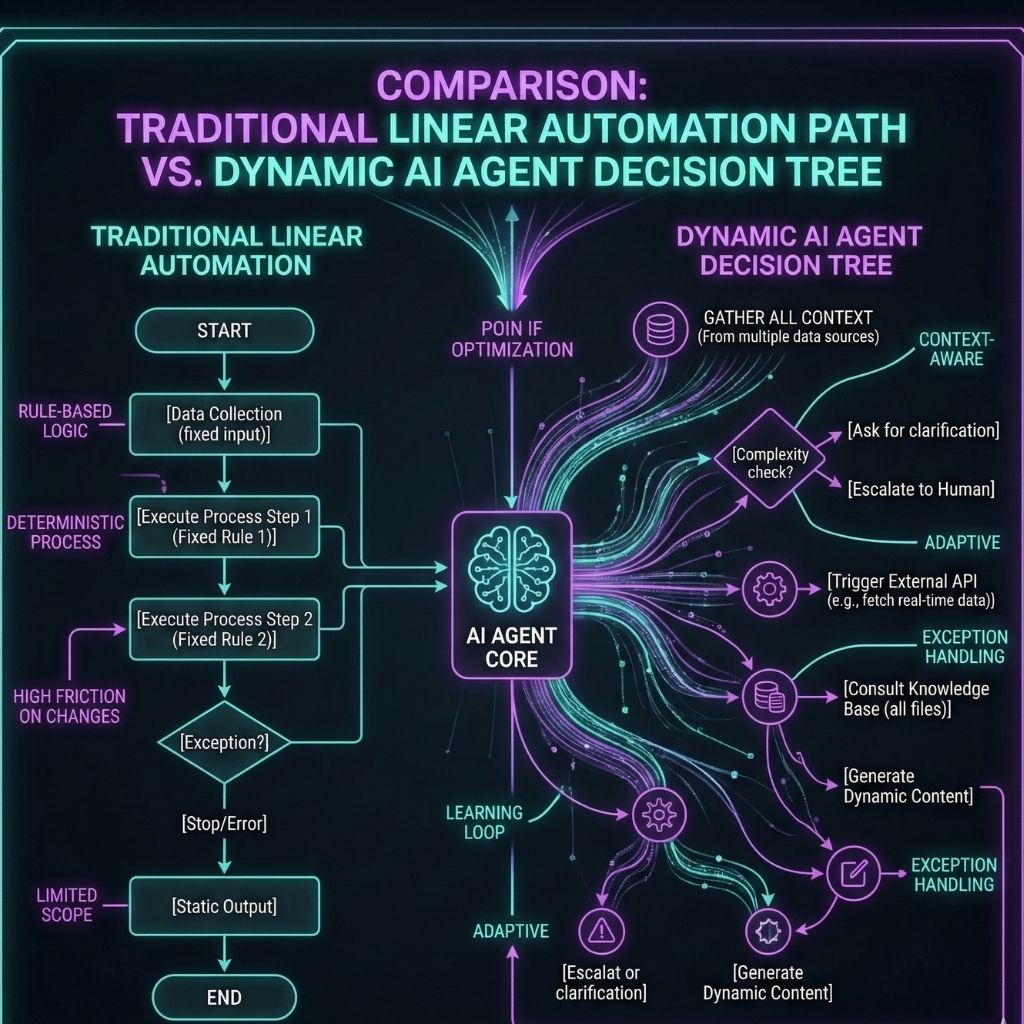
Traditional automation requires structured data. AI automation can process unstructured data. This is a massive paradigm shift. Instead of relying on a perfectly formatted web form to trigger a workflow, an intelligent system can read a messy, rambling email from a client, understand the intent, extract the relevant details, and decide what action to take next. You’ll typically see forward-thinking companies deploying these systems for complex triage like an AI agent reading incoming support tickets, categorizing the severity, drafting a custom reply based on company documentation, and escalating only the most nuanced problems to human staff.
Building custom autonomous agents
We are moving away from linear workflows into the era of “AI Agents.” An agent is given a goal, a set of tools (like access to your CRM or your internal database), and the autonomy to figure out the steps required to achieve that goal.
For example, an intelligent system designed for sales ops could be told to “Research this list of 50 companies.” The AI agent will independently browse their websites, read their recent press releases, summarize their current business challenges, and drop a customized briefing document into your sales team’s Slack channel before their morning meeting.
The new hybrid workforce
Implementing AI automation doesn’t mean firing your team; it means elevating them. By building intelligent systems to handle the repetitive, data-heavy, and cognitive-light tasks, you free up your human employees to focus on strategy, relationship building, and high-level problem-solving. Businesses that adopt these custom, reasoning-based automations will simply move faster and operate leaner than those still relying on rigid, rule-based legacy systems.